The Best of Both Worlds.
5 min read
Meca-quartz is a hybrid. The timekeeping runs on quartz, powered by a battery, regulated by a crystal oscillating at 32,768 Hz. Accurate to roughly 20 seconds per month. No winding, no rotor, no mainspring.
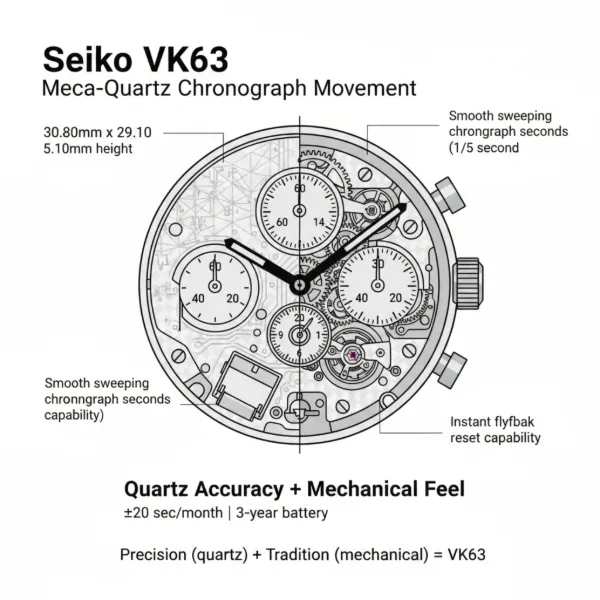
The chronograph runs on mechanical components. Real gears, real levers, real springs. When you press the pushers, you feel resistance. When you reset, the hand snaps back to zero with the same precision you would expect from a fully mechanical chronograph.
One battery powers both systems. Two philosophies inside the same case.
Why it exists
A fully mechanical chronograph movement is expensive to produce, expensive to service, and adds thickness to the case. A fully quartz chronograph is affordable and accurate but feels lifeless. The pushers click with no resistance. The hands tick instead of sweep. The experience is functional but flat.
Meca-quartz solves both problems. It borrows the accuracy and low maintenance of quartz for the part that needs it most (keeping time) and keeps the mechanical module for the part where experience matters most (the chronograph). The result is a watch that costs a fraction of a mechanical chronograph but feels like one where it counts.
The Seiko connection
The term "meca-quartz" is not an official industry standard. It is a community term that stuck. Seiko does not use it in their marketing. But Seiko, through its subsidiary Seiko Instruments (SII), is the reason it exists in its current form.
The VK series, including the VK63, VK64, and VK68, made this technology available to independent brands at scale. Before that, meca-quartz calibers powered watches from Jaeger-LeCoultre, Omega, and Chopard in the 1980s and 1990s. Those watches cost thousands. Today, the same fundamental technology sits inside microbrands priced under $500.
The designer's take
What makes meca-quartz interesting from a design perspective is the thickness. A VK68 is 5.1mm tall. A mechanical chronograph like the ETA Valjoux 7750 is 7.9mm. That difference translates directly into slimmer cases and lower profiles on the wrist.
For a designer building a watch with a vintage-inspired silhouette, that matters. The integrated bracelets and curved cases of the 1970s were designed for thin movements. Meca-quartz lets modern brands reference that era honestly, not just aesthetically but structurally.
The trade-off is a battery. Every three years, roughly, you replace it. For some collectors, that disqualifies the entire category. For others, it is a reasonable exchange for a chronograph that keeps accurate time, feels mechanical in the hand, and sits flat on the wrist.
Neither side is wrong. That is what makes this movement worth understanding.
Codex. Entry 002. Horo Log