When a Tailor Meets a Watchmaker.
4 min read
Todd Snyder found Unimatic on Pinterest. Not at a trade show. Not through a distributor. He was scrolling, building mood boards the way designers do, and stopped. Something about the proportions, the restraint, the refusal to decorate for decoration's sake. He reached out. They met. And the result is 100 watches that sold out before most people knew they existed.
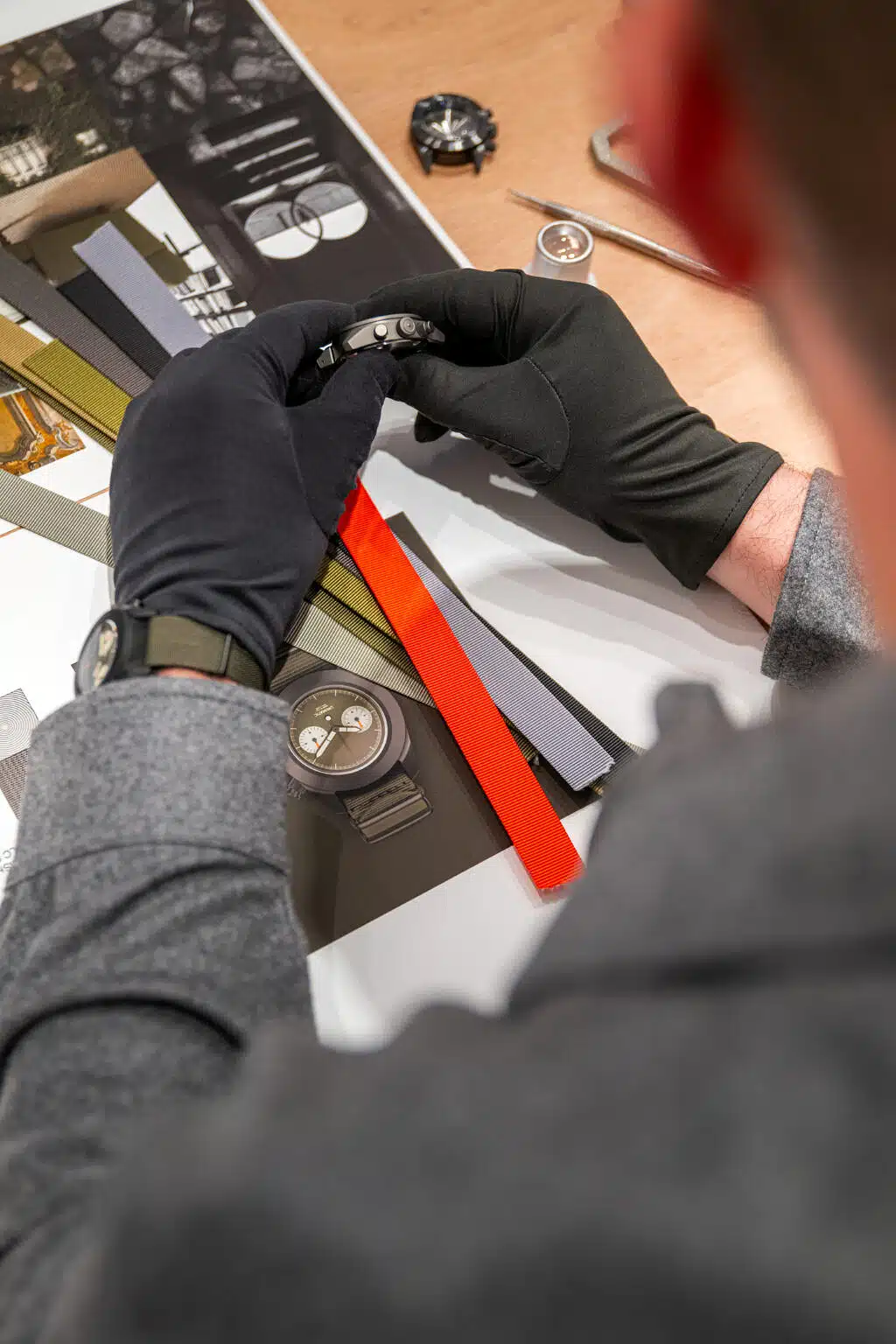
That is how the best collaborations happen. Not through marketing alignment or brand synergy decks. Through one designer recognizing another designer's work and wanting to sit at the same table.
Two schools, one language
Todd Snyder came up through J.Crew, where he revived the Timex Marlin and helped an entire generation reconsider American watchmaking. His aesthetic lives at the intersection of military workwear and Savile Row tailoring. Everything he makes looks like it has been worn before, in the best possible way.
Giovanni Moro and Simone Nunziato, the founders of Unimatic, studied industrial design at the Politecnico di Milano. They spent nearly a decade after graduation working with physical objects, door knobs, lighting, machinery, before making their first watch in 2015. Their brand name blends "unique" with the Greek word automatos. Their design language is brutalist, minimalist, and deeply Italian.
What these three share is a belief that you cannot reinvent the watch. Moro said it directly: you can only know what great designers have been doing for over a century and make your version. That humility is rare. And it shows in the product.
The watch
The Modello Tre U3FB-TS is a fixed bezel chronograph. No rotating bezel, which strips away the diver aesthetic and pushes the design toward something more architectural. The case is 41.5mm wide, 13.7mm thick, solid 316L stainless steel with a sandblasted DLC coating in black. The finish absorbs light instead of reflecting it. On the wrist, it reads as a tool, not a jewel.
The dial is where Snyder's hand becomes visible. Dark olive "reverse panda" with two stone-colored subdials. The international orange accents on the seconds hand and subdial hands are his signature color, the same one that runs through his clothing collections. It is a small detail that transforms the entire composition. Without the orange, this is a stealth military chronograph. With it, there is a pulse of warmth that makes the watch feel considered, not just engineered.
Double-domed sapphire crystal with anti-reflective coating. 300 meters of water resistance. Screw-down crown and pushers. Super-LumiNova C3 on the hands and markers. Seatbelt NATO strap. Every spec points toward a watch that is meant to be used, not preserved.
The movement
Inside sits the Seiko VK64 meca-quartz. The same hybrid technology we covered in the Codex. Quartz accuracy for timekeeping, mechanical module for the chronograph. The pushers have real tactile resistance. The chronograph hand sweeps instead of ticking. Battery life of approximately three years.
At $718 for a limited run of 100, handmade in Italy, with this level of case finishing and a meca-quartz chronograph, the value equation is difficult to argue with. Most fashion brand collaborations use generic movements in generic cases and charge for the name on the dial. This one uses a proven Seiko caliber in a purpose-built Italian case and charges less than the sum of its parts.
What I honestly think
I have never held this watch. It sold out. I am reviewing it from specifications, interviews, and the work of two design teams whose approach I respect.
The collaboration works because neither side compromised. Snyder did not slap his logo on an existing Unimatic. Unimatic did not soften their brutalist language to fit a fashion audience. What they built together is something that neither would have built alone. The olive dial with orange accents is pure Snyder. The sandblasted DLC monoblock case is pure Unimatic. Together, it is neither fashion nor horology. It is design.
The only criticism is the one that applies to every limited run of 100: most people who want it will never get it. And unlike the Speedmaster, there is no continuous production to fall back on. When it is gone, it is gone.
Whether that scarcity is a feature or a flaw depends on where you stand. From a design perspective, I think it is honest. They made what they wanted, in the quantity they could control, and moved on.
That is how designers work.
Main Log. Entry 004. Horo Log