4,000 Hours Before the First Dial.
3 min read
AnOrdain produces eight dials a week. Not eight watches. Eight dials. The rest of the time is spent firing enamel powder at 800°C, watching it fuse to silver, grinding it flat, polishing it transparent, and starting over when it cracks in the final stage.
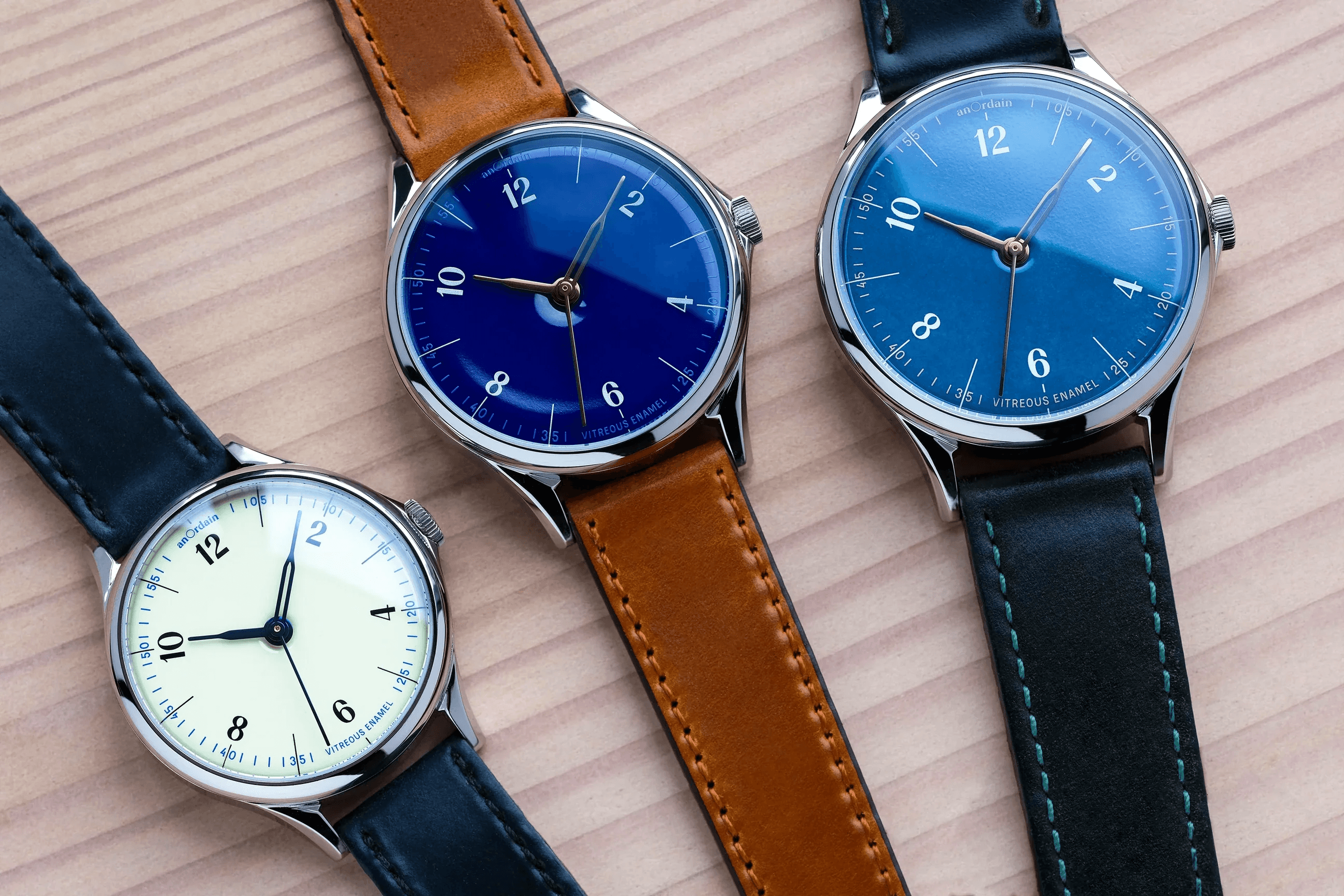
Founded in 2015 by Lewis Heath in Glasgow, the brand started with a team of three. Today they are ten: enamellers, a typographer, a graphic designer, a watchmaker, and a product designer. Their maximum annual output is around 380 watches. Their waiting list is months long. Their motto is "Old Crafts, New Hands."
This is not a brand that scales. This is a brand that insists.
The dial is the product
Most watch brands outsource their dials to specialist manufacturers. AnOrdain makes theirs in-house, by hand, using vitreous Grand Feu enamel, one of the oldest and most difficult decorative techniques in horology. Ground glass powder is painted onto a metal disc, fired in a kiln until it melts and bonds to the surface, then ground and polished. Each color reacts differently. Each firing carries the risk of cracking, warping, or bubbling. There is no undo.
Their silversmith spent over 4,000 hours at the bench before the process was reliable enough to produce consistently. And the most famous result, the fumé dial, came from an accident. While experimenting with silver bases instead of the traditional copper, the team noticed the enamel turned translucent, creating a gradient that darkened toward the edges. They spent a year perfecting what chance had revealed.
The effect is unlike any painted or lacquered fumé. The color has physical depth. Light enters the enamel, refracts through the translucent glass layers, and hits the textured silver surface underneath. The dial appears to glow from within. In photographs it looks impressive. In person, according to every owner review, it stops conversation.
The design around it
The Model 1 is 38mm in diameter, 11mm thick, with a case that stays deliberately quiet so the dial can speak. The typography was developed in-house by their typographer, inspired by vintage Ordnance Survey maps of the Scottish Highlands. Two typefaces share the dial: one for hours, one for minutes. Complementary but distinct. The hands are heat-tempered steel, polished and treated to a straw-gold finish, each one done individually.
The movement options include the Sellita SW210 (hand-wound) and the La Joux-Perret G101 (automatic). Swiss calibers, reliable and serviceable. After assembly, AnOrdain regulates each movement individually. They even ask which wrist you wear your watch on, because it affects positional accuracy.
The caseback can be engraved with a map of Scotland. The packaging is recyclable cardboard with a handwritten note inside. The initials of the enameller who made your dial and the watchmaker who assembled your watch are included. Every detail reinforces the same message: someone made this for you.
Why this matters
Enamel dials traditionally belong to brands charging $10,000 and above. H. Moser, Jaquet Droz, Patek Philippe. AnOrdain starts at around $1,500. They are not competing on specs, on water resistance, on complications. They are competing on a single craft executed at a level that established houses charge five to ten times more for.
As a designer, what I find most compelling about AnOrdain is not the enamel itself. It is the decision to build an entire company around mastering one technique. Everything else, the case, the movement, the packaging, exists in service of that dial. That focus is rare. And it produces objects that feel closer to art than to product.
The waiting list exists because eight dials a week is eight dials a week. Not because they want to create scarcity. Because that is how long glass takes to fuse to metal when you refuse to cut corners.
Scout. Entry 002. Horo Log