The Watch That Did Not Need a Campaign.
7 min read
In 1962, astronaut Wally Schirra strapped his personal Speedmaster to his wrist and boarded the Sigma 7 capsule. He orbited Earth six times in nine hours. No one at Omega knew their watch was going to space that day.
Three years later, NASA put every major chronograph brand through a series of tests designed to simulate the worst conditions a watch could face: extreme heat, freezing cold, vacuum, vibration, humidity, compression, acceleration, decompression. Rolex was tested. Longines-Wittnauer was tested. Omega was tested. Only the Speedmaster survived all of them.
That is how a racing chronograph became the most famous watch in history. Not through advertising. Through performance under conditions no marketing team could have imagined.
The origin no brand can buy
The Breakdown framework teaches that a product's narrative is built from three layers: core (materials, process, origin), strategic (scarcity, exclusivity), and external (the people, environments, and situations connected to the product). The Speedmaster is the ultimate case study of the external layer doing all the work.
Omega did not design the Speedmaster for space. They designed it for racing drivers. The tachymetric scale on the bezel was meant to calculate average speed over a known distance. But when Buzz Aldrin stepped onto the lunar surface in July 1969 with a Speedmaster on his wrist, none of that mattered anymore.
The watch was no longer a tool for timing laps. It was the watch that went to the moon.
No advertising budget in the world can create that kind of origin story. You cannot manufacture it. You cannot fake it. It either happens or it does not. And for Omega, it happened six times across six different lunar landings.
Through the eyes of a designer
I do not own a Speedmaster. At $7,000 for the current Moonwatch Professional, it is outside my reach right now. But I have studied this watch the way I study any iconic design: by understanding what decisions were made and why they survived.
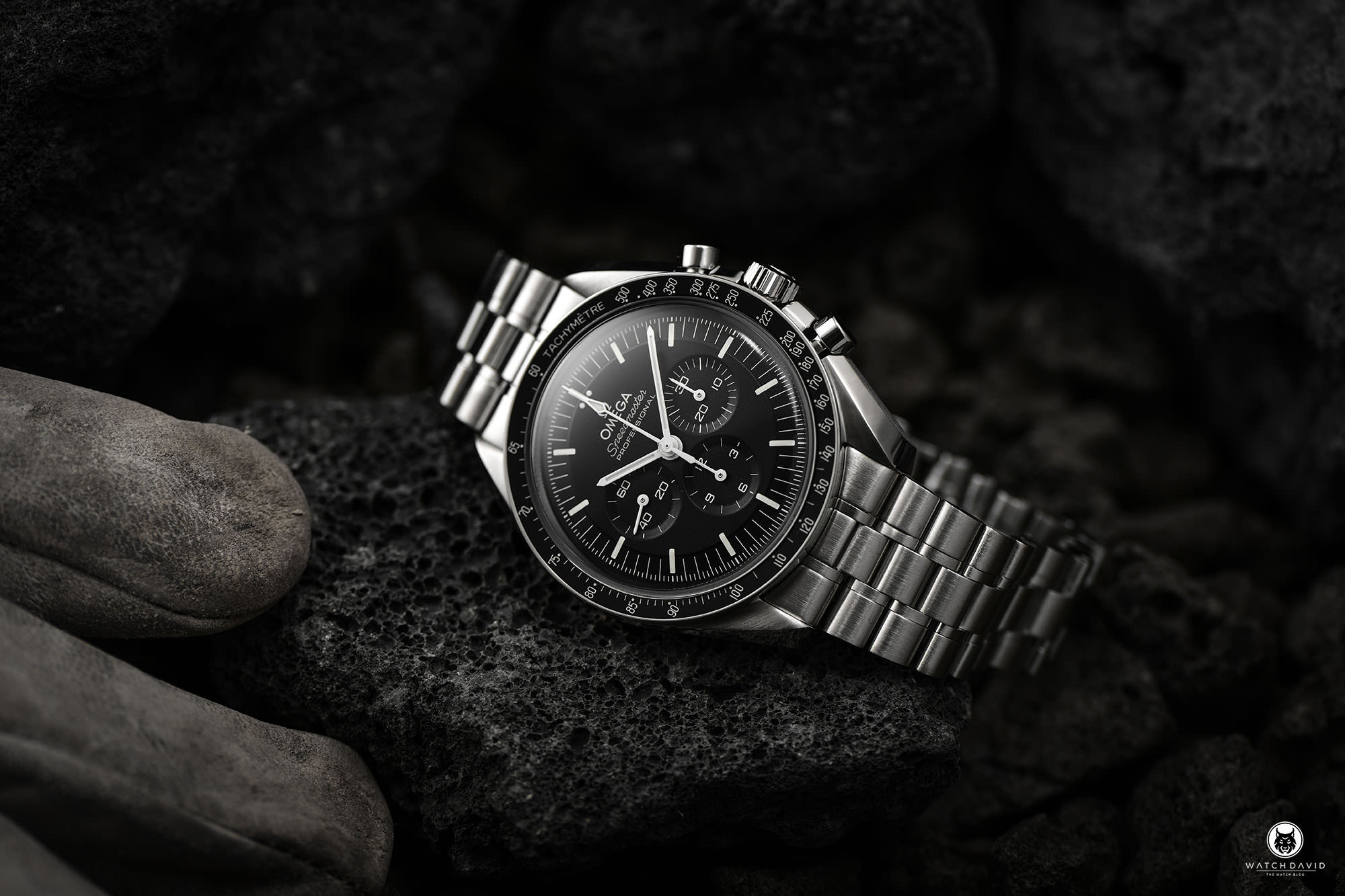
The case is 42mm, asymmetric, with twisted lugs. Those lugs are not decorative. They curve to follow the shape of the wrist, a decision that keeps the watch stable during physical activity. The step dial, where the surface drops slightly at the subdials, creates physical depth without adding thickness to the case. At 13.18mm thick, it wears flatter than most chronographs.
The Hesalite crystal is a deliberate anachronism. Omega offers both Hesalite (acrylic) and sapphire versions. Hesalite scratches easier but does not shatter under impact, which is exactly why NASA chose it. It also creates a warmer, softer visual tone on the dial compared to the clinical clarity of sapphire. Two versions of the same watch, same movement, different experience. That is a design decision worth studying.
The bezel is anodised aluminium with the tachymeter scale. The famous "dot over ninety" is a detail collectors obsess over. From a design perspective, what matters more is how the bezel's matte finish contrasts with the polished case, creating visual separation between the instrument (bezel) and the object (case). Function and aesthetics working together without competing.
The movement
The current Moonwatch Professional runs on the Calibre 3861, a manual-winding chronograph certified as a Master Chronometer. It resists magnetic fields up to 15,000 gauss. The power reserve is 50 hours. The frequency is 21,600 vibrations per hour.
But what makes this movement significant is not the numbers. It is the lineage. The 3861 descends from the Calibre 321, the movement that was inside the watches that went to space. Omega has refined it over six decades, but the fundamental architecture remains. Manual winding, column wheel chronograph, three subdials. The bones are the same.
Manual winding in 2026 is a choice. Most chronographs at this price point are automatic. Omega kept the Moonwatch manual because the original was manual, and because there is something intentional about winding your watch every morning. It asks something of you, the same way the Axel Elite Silver does. Different price, different heritage, same principle.
What I honestly think
The Omega Speedmaster Moonwatch is not the best chronograph you can buy for $7,000. There are arguments for the Zenith El Primero, the Tudor Black Bay Chrono, and others in that range. The finishing on the 3861 is good but not exceptional for the price. The bracelet, while improved with micro-adjustments, still divides opinions.
But none of those watches went to the moon.
And that is the honest truth about the Speedmaster. Its value is not entirely in the metal, the movement, or the finishing. Its value lives in a story that no competitor can replicate. When you wear a Moonwatch, you are wearing the same design that timed the critical 14-second engine burn that brought the Apollo 13 crew home alive.
That story is not marketing. It is history. And history, as it turns out, is the most powerful narrative a product can carry.
Is it worth $7,000? That depends on what you are buying. A chronograph? Probably not. A piece of human achievement on your wrist? That is harder to price.